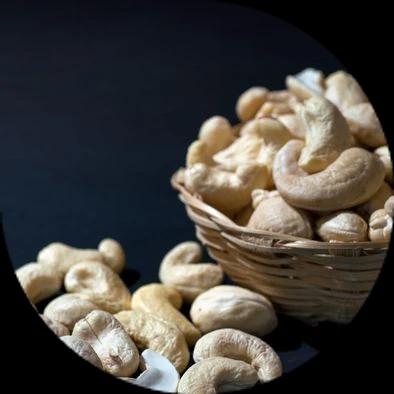
The steps that turn a raw cashew nut into an export-ready kernel: drying, steaming, shelling, peeling, grading and packing, and what each means for buyers.
5 min read
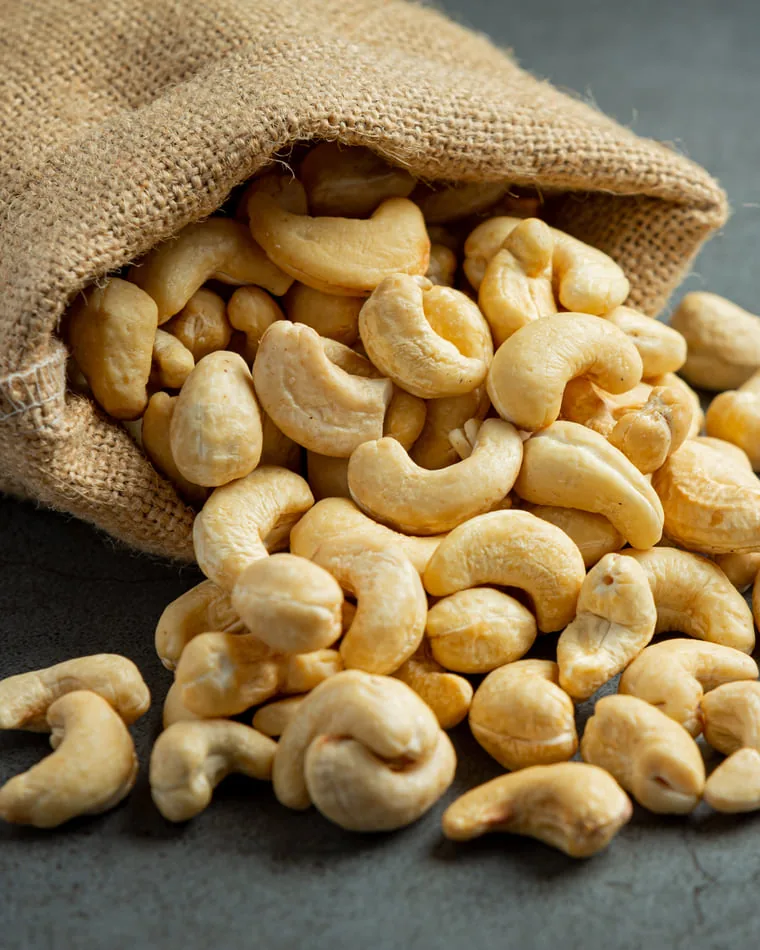
A cashew kernel is one of the more labour-intensive foods in international trade. Each nut is handled individually several times before it reaches a carton, and every step affects the grade, colour and price of what a buyer receives.
Understanding the process helps you read a specification, ask better questions and judge whether a supplier's quality claims are plausible. Methods and equipment vary between processors and origins; this guide describes the steps most plants have in common.
The raw material
The cashew tree, Anacardium occidentale, produces a fleshy, pear-shaped "cashew apple". The true fruit is the kidney-shaped nut that hangs beneath it. Inside the nut's hard double shell sits the kernel, wrapped in a thin reddish-brown skin called the testa.
The shell is the reason cashews are not sold to consumers in shell. Between its layers is a caustic oil, cashew nut shell liquid (CNSL), which irritates skin and must be kept away from the kernel. Much of the processing exists to remove the kernel cleanly without contaminating or breaking it.
The unprocessed nut in its shell is traded as raw cashew nut (RCN).
Step 1: Harvest and drying of raw nuts
Ripe cashew apples fall from the tree, and the nuts are collected and detached from the apple. They are then dried, usually in the sun, to bring the moisture down to a level at which they can be stored for months without mould or deterioration.
Processors assess raw nuts on a few measures before buying:
- Nut count, the number of nuts per kilogram, which indicates size.
- Kernel outturn, an estimate of how much usable kernel a given weight of raw nuts will yield.
- Moisture and the share of defective nuts.
Poorly dried or badly stored raw nuts produce kernels with spots, off-flavours and poor colour, whatever the factory does later.
Step 2: Cleaning and sizing
Raw nuts are cleaned of stones, sand and plant matter, then sorted by size. Uniform size matters because later steps, particularly steaming and mechanical shelling, are set for a particular nut size.
Step 3: Heat treatment
The shell is too tough and elastic to open cleanly without treatment. Heat makes it brittle and loosens the kernel from the shell. The main methods are:
- Steam cooking. Nuts are steamed under pressure for a short time and then cooled. This is the most common modern method and tends to give paler kernels.
- Drum roasting. Nuts are roasted in a rotating drum. A traditional method that is faster but gives a higher share of scorched kernels.
This step is why "raw" cashew kernels sold to consumers have always been heat-treated at least once.
Step 4: Shelling
The shell is cut or cracked open and the kernel, still in its testa, is removed. Shelling is done by hand with simple cutting tools, by semi-mechanical cutters, or by automatic shelling machines.
This is the stage with the greatest effect on the share of whole kernels. Careful shelling of well-sized nuts gives more wholes; rushed or poorly adjusted shelling gives more splits and pieces.
Step 5: Kernel drying
The shelled kernels are dried in a hot-air oven or dryer for several hours. Drying lowers the kernel's moisture and shrinks it slightly, so that the testa becomes brittle and separates.
Temperature and time are a balance. Too little drying leaves the skin stuck to the kernel. Too much darkens the kernel, moving it from a white grade to a scorched one, and makes it brittle.
Step 6: Peeling
The testa is removed by hand, by machines using compressed air or gentle abrasion, or by a combination of the two, with hand finishing for kernels the machine has not cleaned completely.
Kernels are fragile at this point, so peeling is the second main source of breakage.
Step 7: Grading and sorting
Peeled kernels are sorted into grades by three attributes:
- Wholeness: wholes, butts, splits and pieces.
- Colour: white, scorched and lower colour grades.
- Size: the count per pound for wholes.
Sorting combines sieves and sizing machines, optical colour sorters and trained staff who remove defective kernels by eye. Our guide to cashew kernel grades explains the codes that result, such as W240, W320 and LWP.
Step 8: Final checks and packing
Before packing, kernels are checked again and typically passed through metal detection. Moisture is brought to the level set in the specification: dry enough to keep, but not so dry that kernels shatter in transit.
Export kernels are usually packed in vacuum-sealed bags flushed with an inert gas and placed in cartons.
Where quality is won or lost
| Stage | What can go wrong | What the buyer sees |
|---|---|---|
| Raw nut drying and storage | Mould, internal spotting, off-flavours | Spotted or discoloured kernels, poor taste |
| Heat treatment | Overheating | More scorched kernels, darker colour |
| Shelling | Poor cutting, shell liquid contact | More brokens, stained or bitter kernels |
| Peeling | Rough handling, incomplete peeling | Brokens, adhering testa |
| Packing and storage | Poor seal, high moisture | Rancidity, infestation, loss of crispness |
What this means when you buy
- Wholes cost more for a reason. Each handling step breaks some kernels, so intact, pale, large kernels are the scarcest output.
- Ask about the process. Steaming or roasting, manual or mechanical shelling and peeling, and how grading is checked all affect consistency.
- Ask about food-safety controls. Hygiene, pest control, metal detection, traceability by lot and any certification the plant holds.
- Confirm with inspection. A count, a broken percentage and a moisture reading before loading tell you more than any brochure. See our guide to pre-shipment inspection.
Sourcing cashew kernels
Sila Trade X is a trading company that helps buyers source cashew products. If you are planning a purchase, request a quote with the grade, quantity, packing and destination, and we will come back with the next steps.
This article is general guidance, not legal, tax or customs advice. Rules change; confirm requirements for your shipment with the relevant authorities.
Back to insights