A plain-language glossary of the timber terms on quotes and contracts: sawn and planed, green and kiln-dried, moisture content, grades and volume units.
5 min read
Timber quotes are full of short terms and abbreviations: KD, AD, S4S, FAS, nominal size. Each one changes what you receive and what you pay. Misreading a single term can mean boards that are thinner than expected, wetter than your factory can use, or of a grade that yields far less usable wood.
This guide explains the terms that appear most often, in the order you are likely to meet them.
Forms of timber
- Logs (roundwood). Felled trees, with or without bark, before sawing.
- Sawn timber (lumber). Logs cut lengthwise into boards, planks or beams. "Rough sawn" means the surfaces are left as they came off the saw.
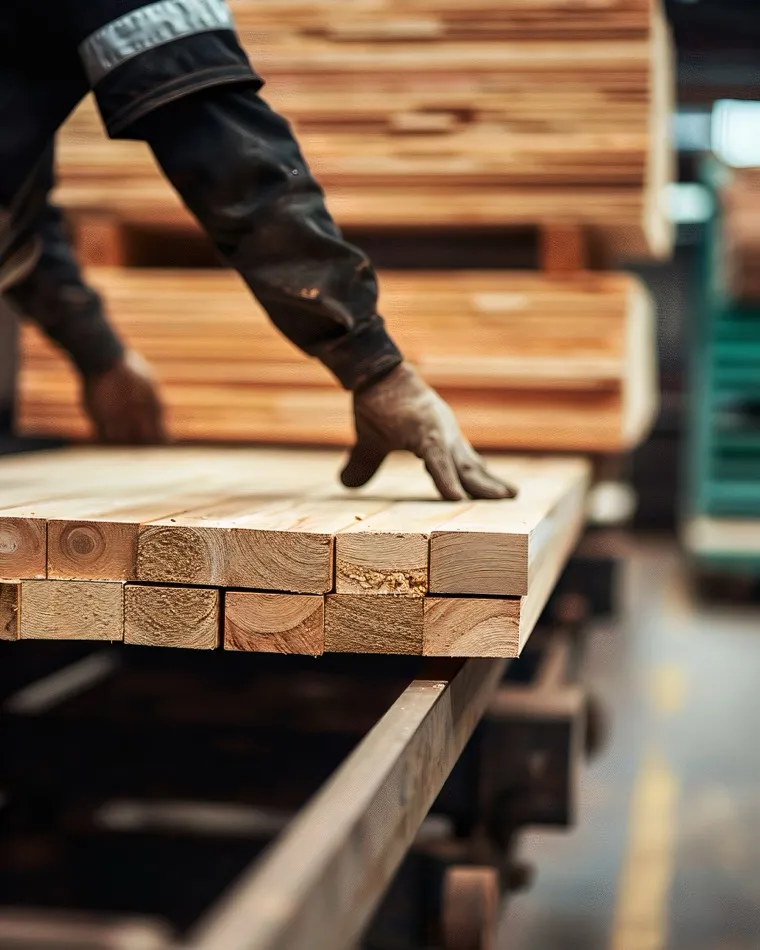
- Planed or surfaced timber. Sawn timber machined smooth to a consistent size. S2S means surfaced on two sides; S4S means surfaced on four sides.
- Engineered wood. Products made by bonding wood layers, strands or fibres, such as plywood, MDF, particleboard and glued laminated timber.
Hardwood and softwood
These are botanical terms, not a measure of hardness. Hardwoods come from broad-leaved trees such as oak, teak or beech. Softwoods come from conifers such as pine, spruce or fir. Some hardwoods are soft and light, and some softwoods are relatively hard. Always name the species, ideally with its botanical name, because trade names can cover several species.
Moisture and drying
Freshly cut wood contains a great deal of water. As it dries it shrinks, and it may warp or crack if dried badly. How the timber was dried, and to what level, is one of the most important lines in a quote.
- Green. Freshly sawn and not dried.
- Air-dried (AD). Stacked with spacers and left to dry in the open air. The result depends on climate and time.
- Kiln-dried (KD). Dried in a heated chamber under controlled conditions to a target moisture content. This is faster and more consistent, and reaches lower moisture levels than air drying.
- Moisture content (MC). The weight of water in the wood, expressed as a percentage of the oven-dry weight of the wood.
The right moisture content depends on where and how the timber will be used. Wood for interior furniture in a dry, heated or air-conditioned building needs to be drier than wood for outdoor structures. State your target and tolerance in the order and agree how it will be measured. Confirm suitable values with your own technical requirements or the relevant standard.
Two related terms are often confused with kiln drying:
- Heat treated (HT). Heated to a set core temperature to kill pests. It is a plant-health treatment and does not mean the wood is dry.
- Fumigated. Treated with a gas for the same purpose.
Dimensions and volume
Nominal and actual size
Nominal size is the name of the section, often the rough-sawn size before drying and planing. Actual size is what you can measure. Planed timber is smaller than its nominal size. Ask which one the quote refers to, and state tolerances.
Volume units
- Cubic metre (m3) is the common unit in international trade.
- Board foot is used mainly in North America. It equals a piece one foot long, one foot wide and one inch thick.
Check whether volume is calculated on nominal or actual dimensions. The difference affects the real price.
Grading
A grade describes the quality of a piece according to a published rule. There are two broad families.
Appearance grades
These classify boards by visible features: knots, colour variation, sapwood, splits, wane (missing wood or bark on an edge) and other defects. Many hardwood grading systems are based on the share of each board that can be cut into clear, defect-free pieces.
North American hardwood rules, for example, use grade names such as FAS, Select and Common. Note that FAS here stands for "Firsts and Seconds", a top appearance grade. It has nothing to do with the Incoterm FAS (Free Alongside Ship).
Structural or strength grades
These classify timber by its load-bearing properties, by visual assessment or by machine. They are used for construction and are defined by building standards. Structural use must follow the codes and engineering requirements of the country where the timber will be installed. This article is not engineering advice.
Grades are not universal
Grading rules differ between countries, species and producers. Some mills use their own house grades. Always name the grading rule in the contract, and where possible agree reference photographs or inspect a sample bundle.
Legality, certification and plant health
- Legal harvest. Several importing markets require importers to show that timber was legally harvested and to carry out due diligence. Ask the supplier which documents they can provide.
- Protected species. Trade in some species is controlled under CITES and needs permits.
- Forest certification. Schemes such as FSC and PEFC certify sustainable forest management and chain of custody. If you need certified material, state the scheme and claim in the order.
- Phytosanitary certificate. Many countries require one for timber imports.
Rules change and differ by country. Confirm current requirements with your customs broker or the competent authority; this is general information, not legal advice.
A checklist for a timber enquiry
- Species (botanical name) and origin
- Form: rough sawn, S2S, S4S, or other
- Dimensions, with nominal or actual stated, and tolerances
- Drying method and moisture content target
- Grade and the grading rule that applies
- Volume and unit
- Certification or legality documents required
- Packing: bundle size, strapping, wrapping, end sealing
- Destination and Incoterm
For help with the last point, see our Incoterms 2020 guide. The wood and timber page gives an overview of the range.
When your requirements are clear, request a quote and include the details above. If some are still open, tell us the end use and we will help you narrow them down.
This article is general guidance, not legal, tax or customs advice. Rules change; confirm requirements for your shipment with the relevant authorities.
Back to insights